
Family Help Together - A Framework for Action (downloadable version)
Guide to using decision making matrix (downloadable version)
Video - Family Help Together - A Framework for Action
Welcome: Our shared responsibility
Our vision is that every child in Shropshire thrives in a safe, supportive home where families feel empowered, and where communities and services work seamlessly together to improve their lives.
Our shared purpose in Shropshire is to keep children safe, supported and able to thrive.
This framework explains what practitioners who work with children must do when they’re worried about a child, how to get help, and how we work together across the system. It sets out how we notice concerns, share information, make decisions and respond when risks increase.
Safeguarding must be inclusive, anti‑racist and anti‑discriminatory with practitioners understanding how poverty, disability, culture and identity shape a child’s life, and ensure support is fair and respectful.
Our promises to children and families
We will:
-
Put children first and act quickly if they are unsafe
-
Value parents and wider family as partners in decisions
-
Be open and honest about what is happening and why
-
Treat everyone with dignity and respect
-
Share information clearly and promptly
Everyone who works with children in Shropshire must use this framework in their policies and day-to-day practice. We will keep updating it as we develop national changes such as the Families First Partnership.
Delegated Safeguarding Partners

David Shaw
Director of Children’s Services
Shropshire Council
Emma Whitworth
Shropshire Local Commander
West Mercia Police
Vanessa Whatley
Chief Nursing Officer
Shropshire, Telford and Wrekin NHS
The way we work
The way we work can make a life changing difference for children and their families. Working Together to Safeguard Children 2026 clearly states that effective safeguarding depends not only on what we do, but how we do it: the relationships we build, the conversations we have, and the way we work together seamlessly across the end-to-end system.
In Shropshire, we are committed to a way of working that is: child‑centred; relationship-based; respectful; trauma‑informed; strengths-focussed; curious and evidence‑based; inclusive and anti‑racist and; multi‑agency.
Children say they want “adults to notice when something isn’t right, listen to us, respect us and stay with us. We want them to understand us, act on what we say, keep us involved, explain decisions, speak up for us, help us get support and keep us safe.”
Practitioners are expected to access and understand The West Midlands Regional Safeguarding Procedures:
Parents and carers told us that support works best when practitioners take time to build trust. They value empathy, respect and genuine curiosity. They do not want to feel blamed or judged. They want practitioners to understand what is happening around the family, including the pressures they face, the strengths they have and the people who support them. Good support is creative and flexible. It is trauma-informed and adapts to what each family needs.
Families want to feel heard, understood, and us to work with them as their partners.
To make a meaningful difference, practitioners working with the same child and family must work as one team to:
· Collaborate: Share information early, build a full picture of the child’s lived experience, and involve parents and carers as partners.
· Learn: Use evidence, share perspectives, and reflect together on what life is like for the child.
· Resource: Build strong relationships across agencies and disciplines so children receive coordinated support and protection.
· Include: Recognise the differences between, and respond to, circumstances when families are experiencing adversity due to poverty, stress or discrimination and situations when children are experiencing harm due to abuse or neglect.
· Mutual challenge: Challenge assumptions, address racism, adultification and discrimination, and resolve differences in a restorative and respectful way.
Our Blended Practice Model
“One shared way of working across Shropshire”
Our blended practice model brings together four complementary approaches, so children and families experience consistent, child‑centred support across the whole system.
Relationship‑based practice is our overarching way of working. This is supported by the principles of restorative practice, trauma‑informed practice and safe uncertainty (known as the other three pillars).
This model helps practitioners build trust, understand the child’s lived experience, and respond confidently, proportionately and at the right time. It also means that children and families experience consistent, child centred practice. This approach reflects our values, strengths and the Families First Partnership vision.
It is trauma‑informed, anti‑racist and anti‑oppressive, with a whole‑system focus on context, pressures and barriers rather than blame, while keeping children, families and their networks at the centre of every decision.
Rolling out this model depends on good training, reflective supervision and ongoing support for all practitioners.
Relationship-based practice. This means practitioners:
· Build trust through consistency and reliability
· Spend time understanding the child’s lived experience
· Notice patterns, strengths and stressors
· Keep the child’s voice central in all decisions
Restorative practice. Working with families as partners. This means that practitioners:
· Use respectful challenge
· Support shared problem‑solving
· Repair relationships where safe
· Are open about worries, expectations and next steps
Trauma-informed practice. Understanding how trauma, stress, discrimination, adversity and past experiences affect how children and adults behave, cope and communicate. This means practitioners:
· Help families feel safe, understood and involved
· Reduce shame, fear and blame
· Stay curious about what sits behind behaviour
· Understand pressures, triggers and unmet needs
Safe uncertainty. Staying open‑minded and avoid making assumptions, so decisions are based on evidence. This means practitioners:
· Ask what do we know, what don’t we know and what do we need to check
· Consider different explanations for what we see
· Use supervision and multi‑agency discussion to test thinking
· Are clear about the next safest steps
How the blended model applies across our system of support
Everyday support and advice, and getting extra help
· Use relationship‑based and restorative approaches to build engagement and understand what matters to the child and family, and agree a proportionate plan where needed
· Use trauma‑informed practice to create safety, reduce shame, and recognise how stress, adversity or discrimination may affect how families present
· Use safe uncertainty to check assumptions early: what do we know, what don’t we know and what we need to check so that decisions are based on evidence rather than assumptions
Getting Family Help
· Continue to use relationship‑based and trauma‑informed principles together to understand the child’s lived experience, notice patterns, strengths, and stressors and explore what might be driving behaviour or difficulties
· Use restorative approaches with families to agree “what needs to change” using respectful challenge and shared problem‑solving
· Use safe uncertainty to explore different explanations for what is happening, including situations where progress appears unclear or inconsistent; use supervision and multi‑agency discussion to test thinking, identify barriers and agree the next safest steps
Child protection (high or multiple needs)
· Use relationship‑based and restorative-based principles to maintain respectful, honest relationships but be clear that the child’s safety comes first, particularly where there is risk of significant harm
· Use trauma‑informed practice to understand how trauma, fear, discrimination or past involvement with services may affect how families respond. This helps avoid bias and blame
· Use safe uncertainty to support timely analysis, strong oversight and challenge, and decisive action when needed. Practitioners stay curious, avoid assumptions, and are clear about the next safest step
Our non‑negotiables
These apply to everyone who works with children and families:
· Act immediately when a child isn’t safe - safety must come first
· Share information early so everyone sees the full picture
· Use supervision and multi‑agency discussions to check our thinking together
· Be clear when concerns must escalate to statutory assessment or child protection
· Record why decisions were made and what evidence was used, and what would change the plan
These expectations ensure that children and families experience consistent, confident and coordinated support across the whole system.
Information Sharing Duty
Worries about sharing information must never delay action to protect a child.
Sharing information early is essential to keeping children safe. No single practitioner or agency has the full picture, so concerns must be shared quickly to understand a child’s lived experience, identify need, assess risk and provide the right support at the right time.
Never assume someone else will pass on critical information.
The Information Sharing Duty means sharing the right information, with the right people, at the right time, for the right safeguarding purpose
The new Information Sharing Duty makes clear that information relevant to safeguarding and promoting a child's welfare must be shared when it may help another organisation or practitioner to:
· Understand a child's needs or lived experience
· Assess risk or need
· Make decisions about support or protection
· Take action to safeguard a child
· Provide help before problems escalate
This includes relevant information about adults or other children connected to a child's life where it may help safeguard or promote their welfare.
The Information Sharing Duty applies both when sharing concerns proactively and when responding to requests from other safeguarding organisations.
Children do not need to meet a statutory threshold before information must be considered for sharing. Information sharing is important for identifying extra help and emerging concerns, as well as child protection.
The Data Protection Act 2018, UK GDPR and the Data (Use and Access) Act 2025 support information sharing for safeguarding purposes. Consent (agreement) is not required to share information when doing so is necessary to safeguard and promote a child's welfare.
Information must not be withheld solely because:
· Consent has not been obtained
· A parent disagrees with sharing
· A practitioner feels unsure or uncomfortable
· There are concerns about data protection alone
If unsure, seek advice from your organisation’s safeguarding lead.
Where safe and practicable, practitioners should be open and transparent with children and families about what is being shared, who it is being shared with and why. Building trust and understanding is important, but transparency must never delay action to protect a child.
Practitioners should clearly record the child’s voice, family views, practitioner analysis and decision-making and any disagreements. Clear recording supports shared understanding and consistent decision‑making.
When might it not be safe to tell the child or parent that you are sharing information?
· Increases the risk of harm to a child
· Could obstruct or interfere with a police investigation
· Places any other person at risk of injury or serious harm
· Would contravene Family Court rules or orders
Always record when, why and on what basis you decided not to inform the child or parent.
Further information
Information sharing to safeguard children and young people - GOV.UK
Sharing personal data with law enforcement authorities | ICO
A 10 step guide to sharing information to safeguard children | ICO
Enabling Family Help Together
All families need support at different times. This support can come from family, friends, volunteers, private services like childcare, or public services such as family help and social work. Every family’s situation is different and needs change over time, so the type of support must adapt too. Early, proportionate help makes the biggest difference for children and families.
Support should always be based on good evidence and shaped by the views of children and their families.
Practitioners must consider how risks or uncertainties affect a child’s safety and wellbeing.
What to do if you are worried about a child:
· If a child is at immediate risk of harm or needs urgent medical attention, call 999 · If you think a child in Shropshire is being harmed or at risk, contact First Point of Contact (FPOC) 0345 678 9021 · For non-urgent concerns please use the Children's Referral Portal · Families can also speak to schools, health visitors, GPs or trusted community organisations |
In Shropshire, we have adapted the i‑THRIVE model to reflect our local values. It is intentionally non‑rigid so support can flex with a child’s changing needs through a seamless, end-to-end system which aligns with the Families First Partnership vision (illustrated below).
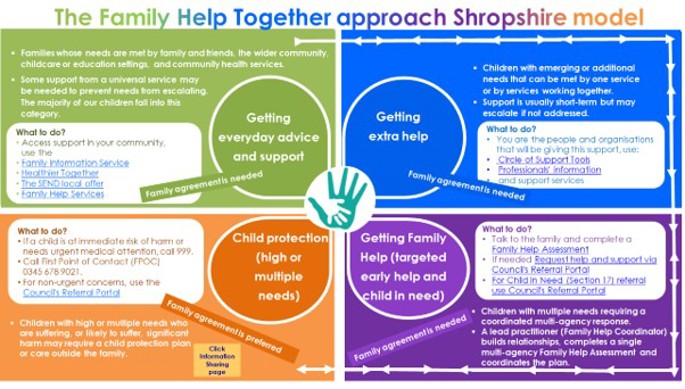
Getting everyday advice and support
At some point, all children and families will need advice or support. This can come from a range of people and places like family and friends, the wider community, childcare or education and community health services (like family doctors (general practitioners), health visitors, school nurses and midwives).
In Shropshire children, families and practitioners can find out more information about who and what support is available from:
· The Family information Service (FIS) which give families the information and resources they need to help their family life run a little smoother
· Healthier Together which provides advice for parents, young people and pregnant women and resources to support healthcare practitioners
· The SEND local offer which is a single place for information, services, and resources for children and young people aged 0-25 with special educational needs and disabilities (SEND), their families, and the practitioners who support them
· The Family Help Services webpage which signposts children and families to information, services, and resources (both virtual and in local communities) in Shropshire
Getting extra help
Sometimes, children and families will need some extra help when they are experiencing problems or difficulties in their lives or when they need more than what is available to them from everyday advice and support. Often, they can get this extra help from their wider family and informal support networks. However, they can also choose to have a conversation with a trusted person or organisation to help them to get the extra help that they need.
Extra help should start with a conversation that explores:
· what extra help they want or need
· what is working well
· what the child and family are worried about
· what support they already have
Conversations may involve other practitioners or trusted people in the family’s network, so families do not have to repeat their story.
Practitioners should use local tools and resources to agree a plan and connect families to the right support. Practitioners are also expected to:
· Understand the local offer
· Stay up to date through the latest news and Locality Networks.
Getting Family Help
Some families experience multiple needs that require a coordinated, multi‑agency response where support may come from a wide range of statutory, and/or specialist services.
Family Help focuses on understanding the child’s lived experience, building on strengths, and providing the right support at the right time.
Family Help brings together targeted early help and Child in Need support under section 17 of the Children Act 1989 into one seamless offer, so families experience consistent relationships, clear planning and support that is flexible rather than rigid as their needs change.
A lead practitioner (Family Help Coordinator) builds a trusted relationship with the family, completes a single multi-agency assessment, and coordinates a single plan with the “team around the family” and also offer Family Group Decision Making (FGDM) services.
This ensures that help is family-led, joined‑up, proportionate and responsive.
The lead practitioner (Family Help Coordinator) should:
· Talk with the family to understand their worries, strengths and what matters to them
· Use local tools and resources to complete a Family Help Assessment and if needed coordinate a multi‑agency family help plan local tools and resources
· Request support if needed via Request for Help and Support
· For Child in Need (section 17) use the Council's Referral Portal
Child Protection (high or multiple needs)
A small number of children have high or multiple needs, disadvantages, or risks that are so significant, that they require specialist or statutory intervention to keep them safe.
Practitioners must act when a child is suffering, or is likely to suffer, significant harm, sometimes even by other children.
This includes harm at home, in foster or residential care, in the community, or online. This harm can include physical, emotional or sexual abuse, neglect, domestic abuse, criminal or sexual exploitation, trafficking, online abuse, or being influenced by extremist ideas.
The Child Protection Procedure for Shropshire has further details.
|
If a child is at immediate risk of harm OR needs urgent medical attention, call 999. THEN Call First Point of Contact (FPOC) 0345 678 9021. If you think the child is not in immediate risk today, use the Children’s Referral Portal (non-urgent concerns). Referrals through Children’s Referral Portal are regularly monitored Monday to Friday |
Further information: Working Together to Safeguarding Children (page 86)
Understanding needs – decision-making
Understanding what life feels like for a child is the starting point for all our work. The "what a child might experience" indicators help practitioners build a picture of the child’s life: what is going well, what is causing worry, and what may be changing over time.
The indicators are not a checklist or a judgement about parents; they are a tool to support thoughtful, curious conversations with children, families and other practitioners.
This helps you understand what life feels like for the child and decide what support is needed using one shared approach across Shropshire to collectively consider strengths and needs during decision-making. The aim is to ensure every family can access the right help at the right time, with a strong focus on early intervention to prevent problems from escalating.
The decision‑making matrix brings together four factors that help us understand what the child needs:
· Frequency and duration: how often something is happening and for how long
· Severity: how serious or intense the concern is
· Impact: how the child’s safety, wellbeing, development or relationships are affected
· Safeguarding risk: why this matters now and whether the child may need protection
Practitioners must consider cumulative harm - worries or unmet needs that build up over time. Even if single incidents seem low‑level, their combined effect can seriously impact a child’s safety, wellbeing or development. Patterns matter as much as individual events.
These factors help practitioners understand whether the child needs everyday advice and support, extra help, Family Help, or a statutory safeguarding response. The highest need reached across the four factors guides the support required.
Strengths are an essential part of this picture. They do not remove risk, but they help practitioners understand what is keeping the child safe, what is working well, and what can be built on in planning. Strengths also help explain why a child may not need statutory support, even when there are concerns.
Decision‑making should always be shared wherever possible. Practitioners should record the child’s voice, the family’s views, practitioner analysis, and any areas of disagreement. This supports transparency, helps children and families understand how decisions were made, and ensures that plans are clear, proportionate and strengths based.
Decision‑making Matrix
|
Factor |
Getting everyday advice and support |
Getting Extra Help |
Getting Family Help* |
Child Protection |
|
|
Targeted Early Help |
Child in Need |
||||
|
How often is this happening? |
Never / One‑off |
Occasional |
Persistent concerns that require coordinated support |
Persistent and multiple needs where the child’s development is being significantly impaired |
Constant / escalating |
|
How severe is it? |
Mild |
Moderate |
Significant but manageable with multi‑agency support |
Significant and likely to worsen without statutory oversight |
Severe / acute |
|
What is the impact on the child? |
Minimal |
Noticeable |
Harmful but not yet causing significant impairment |
Harmful with clear evidence of significant impairment to health or development |
Serious harm / trauma |
|
What is the safeguarding risk? |
None / no immediate risk |
Emerging risk |
Clear needs, but no clear safeguarding risk |
Clear safeguarding risk, but not immediate; statutory assessment required |
Immediate protection required |
|
* The two Getting Family Help columns for targeted early help and Child in Need (section 17) support triage at the integrated front door. Families should however still experience a single, seamless Family Help offer. |
|||||
This decision-making matrix is designed to support confident, timely and consistent decision‑making across Shropshire. It encourages practitioners to stay curious, test assumptions, and use supervision and multi‑agency discussion to build a full picture of the child’s lived experience. It also ensures that when risks escalate, practitioners act quickly and decisively to keep children safe.
What a child might experience indicators
My voice is heard
|
Strengths and protective factors |
Needs and risks |
|
· I feel listened to because adults give me time · I can say how I feel without worrying about reactions · I understand what’s happening because things are explained in ways that make sense to me · I know who to talk to when I’m worried · My family helps me express myself and ask my views · I have someone I trust who helps me share my feelings |
· I need clearer explanations about decisions or plans · I need help to speak up or adults to check in with me · Others speak for me even when I want to speak myself · I feel my views are ignored or minimised · I agree to keep the peace or feel pressured to agree · I feel unsafe sharing my feelings · Adults tell me not to speak to professionals, hide the truth or to keep secrets · Adults get angry or retaliate when I speak up or share how I feel
|
I am achieving
|
Strengths and protective factors |
Needs and risks |
|
· I enjoy learning and feel proud of my work · I get help quickly and it works for me · I understand my learning and what is expected · I attend regularly and feel part of my class · I feel confident in class and improve with guidance |
· I need extra help to learn or get back into routine · My attendance is slipping and starting to affect progress · I struggle with concentration or behaviour and everyday support isn’t enough · I suddenly struggle to concentrate, sit still or follow instructions because I am worried about things at home · I show big emotional reactions at my early years or educational setting (anger, crying, shutting down) that are unusual for me · I am on a reduced timetable, or at risk of suspension · I feel left behind or unsafe at school · I am not attending education despite support, and this is causing serious harm to my development (educational neglect) · I am missing from education and not receiving a suitable education · I have repeated suspensions or exclusions and there is no clear plan to return safely
|
I am heathy and happy
|
Strengths and protective factors |
Needs and risks |
|
· I am a baby and adults notice my cues (crying, feeding, sleeping, settling) and respond quickly in nurturing ways · I am soothed when I am upset, and adults help me feel calm and safe · I have safe, predictable routines that help me feel secure · Adults enjoy spending time with me, playing, talking and interacting · I show signs of secure attachment (for example, I seek comfort from my caregiver and settle with them) · I feel cared for and supported emotionally · I get to my health appointments, even before I am born, and parents notice when my health changes · I can talk about my feelings and use safe ways to cope · I make healthy choices about food, activity and relationships · I live in a stable home with enough food, clean clothes and a safe environment
|
· I am a baby and my cues (crying, feeding, sleeping, settling) are not noticed or responded to · I am a baby and adults struggle to soothe me or become frustrated when I cry · I am a baby and my weight, growth or development is not as expected and professionals are worried · I am a baby and I am left for long periods without comfort, interaction or supervision · I am a baby and adults do not seek medical help when I am unwell or injured · I am a non‑mobile baby, and I have unexplained bruising, marks or injuries · I have repeated or multiple injuries (for example bruises or fractures) that raise concerns about my care or supervision · I struggle with emotions or relationships which is affecting my wellbeing · I need help getting to appointments or with medication · My parents don’t always notice health changes or follow advice · I don’t get help for my disability or illness · My home is unstable or unclean and affecting my health · I use harmful coping strategies or hurt myself when overwhelmed · I am regularly hurting myself and sometimes trying to end my life · I am using drugs or alcohol in ways that put me at significant risk · I am not receiving essential or timely medical treatment, and my health is in danger · My parents/carers seek unnecessary medical interventions for me (possible fabricated or induced illness) · I have been in hospital for three months or more and professionals are worried about my care or home environment · I am over 13 and experiencing repeated pregnancies or sexually transmitted infections (STIs) that are not appropriate for my age · There are indicators that I may be at risk of Female Genital Mutilation (FGM) |
I am supported
|
Strengths and protective factors |
Needs and risks |
|
· I feel loved and valued by my family · I have routines that help me · I get calm guidance and am encouraged to make positive choices · My parents’ model positive behaviour and resolve problems constructively · I have positive relationships and feel comfortable at home |
· I need reassurance or help understanding family stress · Supervision is inconsistent and I sometimes feel unsafe · I feel worried when adults argue or behave unpredictably · I help care for others and it affects my wellbeing · I feel alone, unsupported or treated unfairly · I worry about money or separation at home · My parents/carers have asked someone who is not related to me to care for me for over 28 days (private fostering) · I do not seek comfort from my parent/carer when I am upset, or I avoid them · I cling excessively to adults because I do not feel safe · I show distress when routines change because I rely on predictability to feel safe |
Harm outside the home (extra-familial harm)
Some children experience abuse or exploitation outside the home, including those in residential or foster care. This is often referred to as extra‑familial harm and can occur in peer groups, schools, communities, public spaces and online.
Practitioners should consider risks from peers (bullying, exploitation, gang association), community contexts (unsafe spaces, online harm) and public/online environments. Harm may be caused by children or adults, acting alone or in groups. It includes criminal exploitation, serious violence, modern slavery and trafficking, online harm and child sexual exploitation and influences of extremism that may lead to radicalisation.
Some children are at greater risk, including those with special educational needs and disabilities (SEND), children missing from home, care or education, children in care, and those with previous experiences of abuse or neglect.
Parents and carers are often very worried about their child’s safety outside the home. Their concerns should be taken seriously, responded to without blame or judgement, and by working with them as partners in safeguarding.
All children need a safeguarding response, including children who may be harming others.
We also need to be aware of adultification - where a child is seen as older or more able to cope than they really are. When that happens, their needs can be misunderstood and missed, and they may not get the help or protection they need. This is something we see more often for Black children, children from minoritised backgrounds, children in care, and children involved with youth justice.
As practitioners, we need to stay curious and look at the full context of what is happening in a child’s life. That means thinking about things like coercion, trauma, adversity, and the impact of SEND, and understanding how those factors may be affecting their vulnerability.
Help and support for children in Shropshire can be found here. Concerns can also be reported via the Children’s Referral Portal.
Further information:
· Safeguarding children not in school
Children with specific needs or in special circumstances
Some children will need us to think a bit more carefully about their circumstances and the support around them.
This includes children with special educational needs and Disabilities (SEND), young carers, children in care, care leavers, children living away from home, and children who are homeless.
These children may face extra challenges or vulnerabilities, so it is important that we take those into account when assessing need, risk and support.
The key message is that we need to recognise those additional circumstances and make sure our response is right for the child’s situation.
Further information:
Children who have special education needs and disabilities (SEND) and their carers
Children with special educational needs and disabilities (SEND) are children first and should be able to access everything they need from everyday advice and support that is available to them.
When we’re thinking about children with SEND, it’s important that we look at the whole picture and work alongside families to offer the right level of support at the right time.
We also need to recognise that some disabled children may be more vulnerable to harm, and their needs can change as they grow and as family circumstances change.
Early support is really important because it can stop problems from getting worse. Practitioners should know about The SEND local offer and the help, support and protection that can be given via community hubs and multi-agency teams.
A referral may be appropriate:
· Where the child’s main needs relate to their disability OR
· Where parents request a section 17 Child in Need assessment via the Council's Referral Portal.
Where the child may be at significant risk of harm refer via the First Point of Contact (FPOC) 0345 678 9021.
When the needs of a disabled child are assessed, we also need to think about the carers and whether they need an assessment of their own ability to provide care, so that the right support can be planned around the family.
Further information:
Child‑to‑Parent Abuse (CPA)
Child‑to‑parent abuse (CPA) involves patterns of behaviour where a child uses violence, coercion, intimidation or controlling behaviour towards parents or carers.
All children, including those who may be causing harm to others, should receive a safeguarding response.
CPA may be linked to unmet emotional needs, neurodiversity, trauma, exploitation or family stress.
Practitioners should assess risk, understand the child’s lived experience, and coordinate support through Family Help or Child Protection pathways where required.
Further information:
· Multi-Agency Policy: Child to Parent Abuse (CPA)
Children involved in the Youth Justice System
West Mercia Youth Justice Service (WMYJS) work with children who come to the attention of the police.
If a child is being assessed under section 17 or section 47, Youth Justice practitioners contribute to that assessment. Equally youth justice assessments take account of any assessment and plans that are already in place for the child, so that work is joined up and not duplicated.
The service completes assessments for children across prevention, diversion, out-of-court disposals and statutory court-ordered work. For children who are not on a court order, a Prevention and Diversion Assessment is completed with the child and their family. This helps identify their needs, strengths and the support needed to reduce risk.
For children on statutory interventions, the assessment used is AssetPlus. This looks at offending behaviour, identifies strengths, and helps inform court reports and intervention plans that support the child’s needs, safety and wellbeing.
If a child becomes looked after because they are remanded to youth detention accommodation, Children’s Social Care completes a full assessment and care plan. Reviews then follow the same process as they would for any other looked after child. Visits may also be carried out jointly with the youth justice worker to reduce duplication and support joined-up planning.
Managing professional disagreements
In safeguarding work, professionals will not always agree, and that is to be expected. Different agencies and different practitioners bring different knowledge, experience and perspectives. Every practitioner’s view should be heard, considered and treated with respect, even when we disagree.
Sometimes there will be concerns about decisions, actions, or when not enough action has been taken. When that happens, it is important that those concerns are raised early and discussed openly.
Escalation should not be seen as conflict or criticism. Escalation is part of good safeguarding practice and shows a shared commitment to getting the best outcome for the child. The focus should always stay on the child’s safety and lived experience, making sure concerns are resolved in a timely and constructive way.
What matters is that concerns are raised early, explored openly and resolved in a way that keeps the child’s safety and lived experience at the centre.
All agencies need to make sure their staff feel supported and know how to escalate concerns about a child’s welfare or if they disagree with a decision. Staff should feel confident raising those concerns and using the multi-agency resolution / escalation procedure for professionals’ disagreements or concerns when needed.
Further information
Further information, including important safeguarding contacts, support services and organisations, definitions, signs and indicators of abuse and useful websites can be found here.
Email SSCPBusinessUnit@shropshire.gov.uk with any queries or feedback about this document: Family Help Together - A Framework for Action.